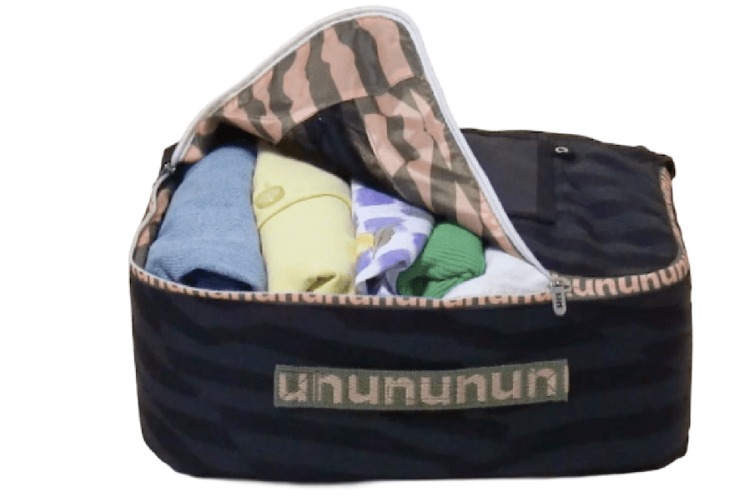
In the spring of 2025, I began to notice a certain striped gray bag everywhere, piled on top of each other in my school’s mailroom, flaunted on my TikTok For You Page (FYP), and even overwhelming the mailboxes hidden in the vast tunnel systems beneath Capitol Hill.
These bags belong to Nuuly, a clothing subscription service founded in 2019 by URBN, the parent company of trendy brands like Urban Outfitters, Anthropologie, and Free People. For $98 a month, the service’s 300,000 subscribers can pick 6 clothing items to have delivered monthly. Items are chosen through a competitive process on the website, with users stalking the perfect style for their vacation, workday, or date night well in advance. When the month is over, the clothes are shipped back, unless you wish to purchase any of the pieces for a steep discount. The square Nuuly bags carry URBN pieces back and forth. A leather jacket is exchanged for a floral dress, then, next month, replaced with a pair of blue jeans.
The argument for Nuuly’s role in developing one’s “Personal style” assumes that Nuuly sources its clothes from a diverse range of suppliers and indie designers, forcing users to step outside their fashion comfort zones. However, in reality, it is pre-selecting clothes from URBN’s incredibly popular family of brands, which is already how many people (and likely many Nuuly users) buy their clothing. Furthermore, the limited pool of items can lead to a pervasive sameness among its users. Elizabeth Gulino wrote about Nuuly’s impact on her personal style for The Cut, and described noticing “Nuuly pieces out in the wild…All of a sudden, I was surrounded by people wearing the exact clothes I was paying $98 a month for, and they weren’t even mine. In an attempt to find my personal style, I had done the opposite. I had made it worse.” She shared her wardrobe not just with the mannequins dotting URBN brands’ many mall storefronts, but also with every other Nuuly customer who desired a “sustainable” closet refresh. Nuuly is a false promise, one that allows consumers to justify a constant stream of stuff on the grounds that it will aid their self-actualization as environmentally conscious fashionistas who have finally found the Anthropologie shirt-pants combo. It is hard to know what to wear or who to be, and the two often seem so deeply intertwined that trends like “Coastal Grandmother” encompass a lifestyle, a kind of girl, and linen pants.
Nuuly will not change your life, but it may give the appearance of an upgrade due to the sheer barrage of products the Nuuly customer is subjected to. It is the platonic form of shopping in the influencer age, where quantity is the point. Everything is a haul now. I’ve watched at least 10 hauls today of clothes, makeup, and PR unboxings. They are beautifully seductive: the people, the products, and even the photogenic packaging. As I scroll, I can’t help but hope that I will one day have the good fortune to open a perfectly curated box of something, anything. With Nuuly, the haul is democratized. High schoolers and Hill staffers get to unzip Nuuly bags and feel like the influencers we see online, surrounded by a pile of stuff at a fraction of its retail value. But stuff gets old fast, so users send it back for more. They don’t have to pretend to be attached to their clothing. Nuuly is quick, disposable, and postable. Nuuly bags are the new subject of hauls. Women open them for a rapt online audience, describing how they yearned after a particular dress or, alternatively, did not receive any of the items they coveted and were left with a month of ill-fitting clothes. However, even if the clothes leave something to be desired, the promise of the haul itself keeps users coming back for more. Anything to ensure more products are paraded across a screen.
What can’t be easily ring-lit are the wardrobe staples we rely on, the middle school gym shorts, sensible slacks, and worn-in sweaters that are the backbone of a closet. Gulino considered this during her Nuuly breakup, as she realized that “My dark-blue jeans I’ve worn into the ground, my gray oversize blazer I bought in Paris, my go-to tank top for hot summer days — these are all pieces that I love, none of which can be found scrolling through Nuuly.” Instead, Nuuly offers a premiocre influencer experience. Premiocre, a portmanteau that combines premium and mediocre, coined by Venkatesh Rao in 2017, encompasses the chairs, foods, and lifestyles of strivers who settle for inferior versions of the real thing, like the flimsy faux-Eames chairs of The Atlantic writer Amanda Mull, who popularized the term. You may not be Alix Earle, young and beautiful on the Alo yacht, adorned in gifted luxury items. But you can still unbox a bag like the ones she rips open for consumeristic voyeurs (like myself). Maybe in the process, you’ll save the trees and find yourself. Or maybe that will happen with next month’s bag.
