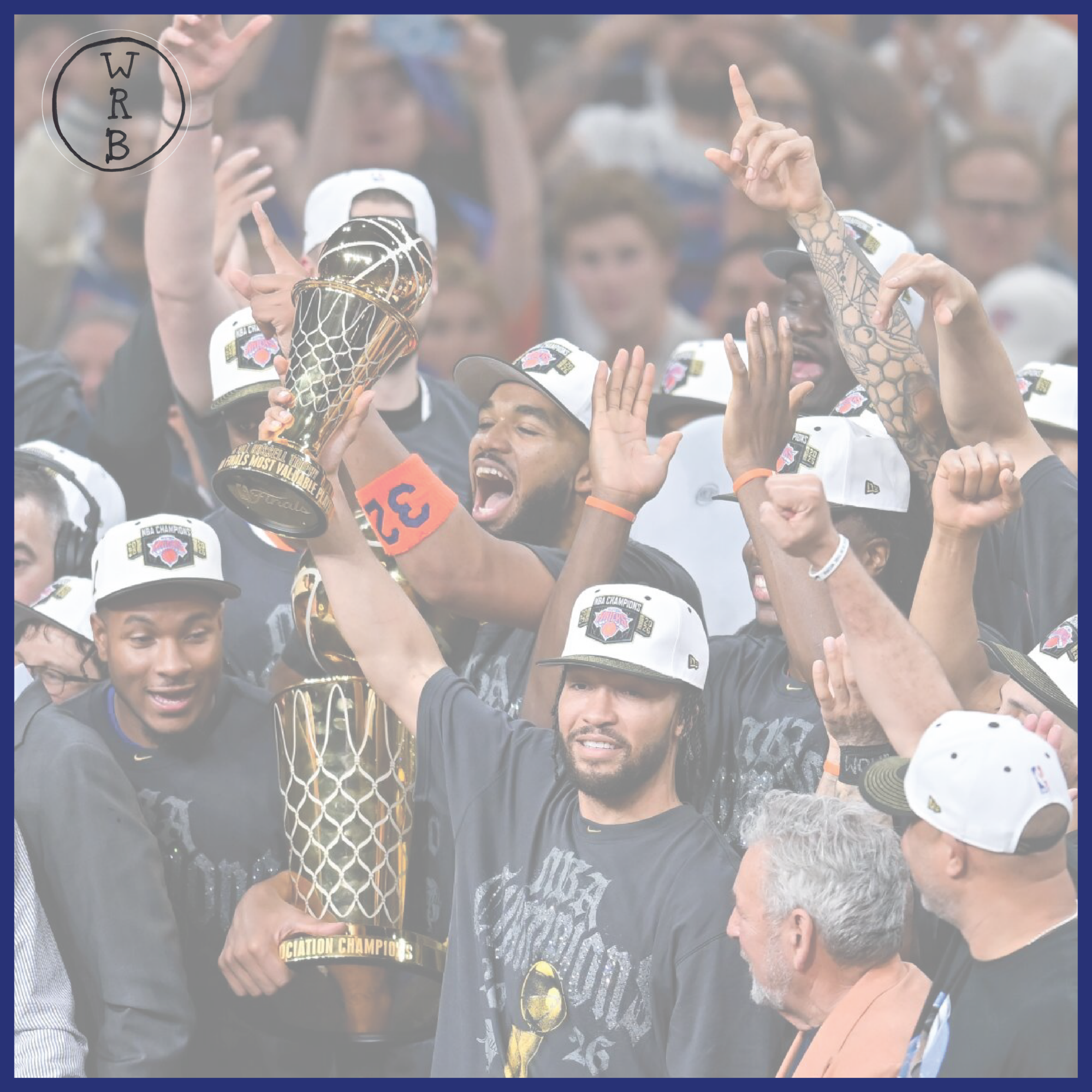
New Yorkers all across the country rejoiced Saturday night as the New York Knicks finally ended their 53-year championship drought, the third-longest in NBA history. The 94-90 come-from-behind win over the San Antonio Spurs caps off what has been an ecstatic two-month playoff run filled with historically dominating victories and last-second comebacks. When the final buzzer rang, tears and cries of joy spilled from both the players and the millions of New Yorkers who had been waiting for this moment for either all or most of their lives.
Watching my Knicks win brought me a level of joy I never thought was possible. Being a Knicks fan has meant enduring years of suffering. I’ve watched 17-win seasons, seasons when “this is the year” felt so realistic, but a loss inevitably came because that’s just what Knicks fans were accustomed to. In 2024, I watched Jalen Brunson break his hand in Game 7 of the Eastern Conference Finals (ECF). In 2025, I watched the Knicks blow a 14-point lead with 2 minutes left in game 1 of the ECF, and I watched Trae Young blow a kiss to Knicks fans after ending our season in 2021, just to name a few heartbreaks. I also watched ownership make decisions that got me questioning whether they actually wanted their team to win. Being a Knicks fan has required a kind of unwavering loyalty. Loyalty, which at times felt irrational, even embarrassing, but all that suffering made Saturday night feel like way more than a win; it felt like a 53-year exhale.
What made this Knicks run special wasn’t just that it ended in Championship glory, it was how they got there and, most importantly, the team they became along the way. It all started with a selfless act. Knicks star Jalen Brunson turned down 113 million dollars in potential earnings, just so the Knicks could recruit better talent to surround him. Brunson’s decision set the tone for the team-first basketball that General Manager Leon Rose and all the players were able to construct. The Knicks weren’t a team relying on one superstar to pick up the slack, or a collection of talented individuals merely playing in proximity to each other. Instead, they were a team that actually seemed to like, trust, and play for one another. Knicks coach Mike Brown trusted his players to be a unit, and you could see it in every extra pass, defensive rotation, and timeout huddle; the team was in it together. There was no ego, no I, only we. That “we” mentality is what allowed them to make a 21-point comeback with only 7 minutes left in the fourth quarter, win a close-out game with the largest margin of victory in history, and, of course, complete the biggest NBA Finals comeback of all time.
The Knicks’ “we” mentality and unwavering chemistry weren’t built in New York alone but in Villanova. Jalen Brunson, Mikal Bridges, and Josh Hart, the so-called “Nova Knicks,” won an NCAA championship together before reuniting on the Knicks 10 years later. They knew each other’s rhythms and tendencies, and they already knew how to win together. When Brunson scored 45 points in the Game 5 clincher, digging the Knicks out of a 16-point hole in the fourth quarter and willing his team to a title, it wasn’t the performance of a lone superstar. It was the performance of a man who knew, without looking, that his longtime best friends were right behind him. Bridges and Hart combined for 27 points in the game 5 victory, contributing massively to the Knicks’ historic championship. Bridges and Hart have always been the kind of players whose value doesn’t show up cleanly in a box score, but their grit and willingness to win at all costs got the Knicks over the finish line. College taught them that. New York let them be that at the highest level.
New York fans saw the “we” mentality and ran with it. Watch parties all over the city were packed with thousands of loyal fans who otherwise would never have spent a night together. Fans squeezed into sidewalks and parks, pressed together to watch the same big screen. Fans shared the same angst, cries, and cheers of joy. In the division and isolation of the modern world, there is something truly remarkable about embracing collective experiences. Sports is perhaps the only arena left where people with nothing in common can forsake their differences and willingly, even happily, stand next to each other and care deeply about the present moment. Sport dissolves the distances we spend our lives maintaining. When the Knicks were on, the city was one. Zohran Mamdami, mayor of New York City, understood the strength sports had in creating a community, stating that “the power of the Knicks is to bring together millions of people from around the world who share nothing in common apart from being New Yorkers in a singular moment of joy, hope and expectation.” That’s the power sports can have.
Mamdami deserves credit for the phenomenon of unity that the Knicks generated. His political identity is built on the idea that the city belongs to all its people, not just those with power and access. Mamdami makes it clear that what makes a city is not just the Jalen Brunsons or the Timothee Chalamets, but the role of the players and the millions of fans across the globe who inspired the Knicks to victory. When Donald Trump’s attendance at Game 3 in Madison Square Garden meant watch parties outside the arena had to be canceled, Mamdami didn’t waver. He found a way to keep the communal energy alive. Mamdami opened a free, 5,000-person watch party in Bryant Park because “these watch parties have become a celebration of New York City itself.” The Knicks belong to all New Yorkers, he kept saying. Whether you’re watching from the Garden or not.
Then there’s Game 3 itself, to which Knicks owner James Dolan invited Trump. It was the only game Trump was in the building for, the only game they dropped in the Finals, and the game that ended their 13-0 winning streak. Trump was booed thunderously by the crowd, and his attendance was accompanied by a security perimeter so vast that the streets were clear of the fans who bring Madison Square Garden to life. The energy outside the arena was gone, and for the first and only time in the Finals, the Knicks couldn’t find their rhythm.
You don’t have to be superstitious to notice that the one night when the face of exclusion and bigotry entered the stadium, the magic didn’t show up. This Knicks team ran all the way to a championship on inclusion, on collectivity, on the radical idea that the whole is greater than any of its parts. That vibe doesn’t survive a security perimeter. It requires open streets, packed sidewalks, and strangers losing their minds together.
The lesson this championship run leaves behind is bigger than basketball. This championship represents what happens when a city becomes a community, a team plays without ego or hierarchy, a mayor’s first instinct is to open more space rather than close it off, and when a city’s joy is treated as a public good rather than a private one. The Knicks symbolized cooperation over individualism and collective will over personal glory. The championship is the trophy. But the community that formed around it, the party that started in Madison Square Garden and extended all the way to Central Park, Bryant Park, and on every bar stool and fire escape in the five boroughs, is the thing worth keeping. That doesn’t go away when the parade ends. It only goes away if we stop choosing it.
